Client management
Know a borrower’s whole history before you lend again
The borrower record is the institution’s memory. When a loan officer resigns, everything they knew about a client is still in the system.

- 1Days late across the whole repayment history
- 2Any amount previously written off
Every loan this borrower has taken from you, and how each one actually went. This is the screen the officer works from at appraisal.
Anatomy of a borrower record
Everything the institution knows, on one screen
A loan officer keeps most of this in their head, and half of it in their phone. When they leave, so does it. Here is the same information written down where the institution owns it.
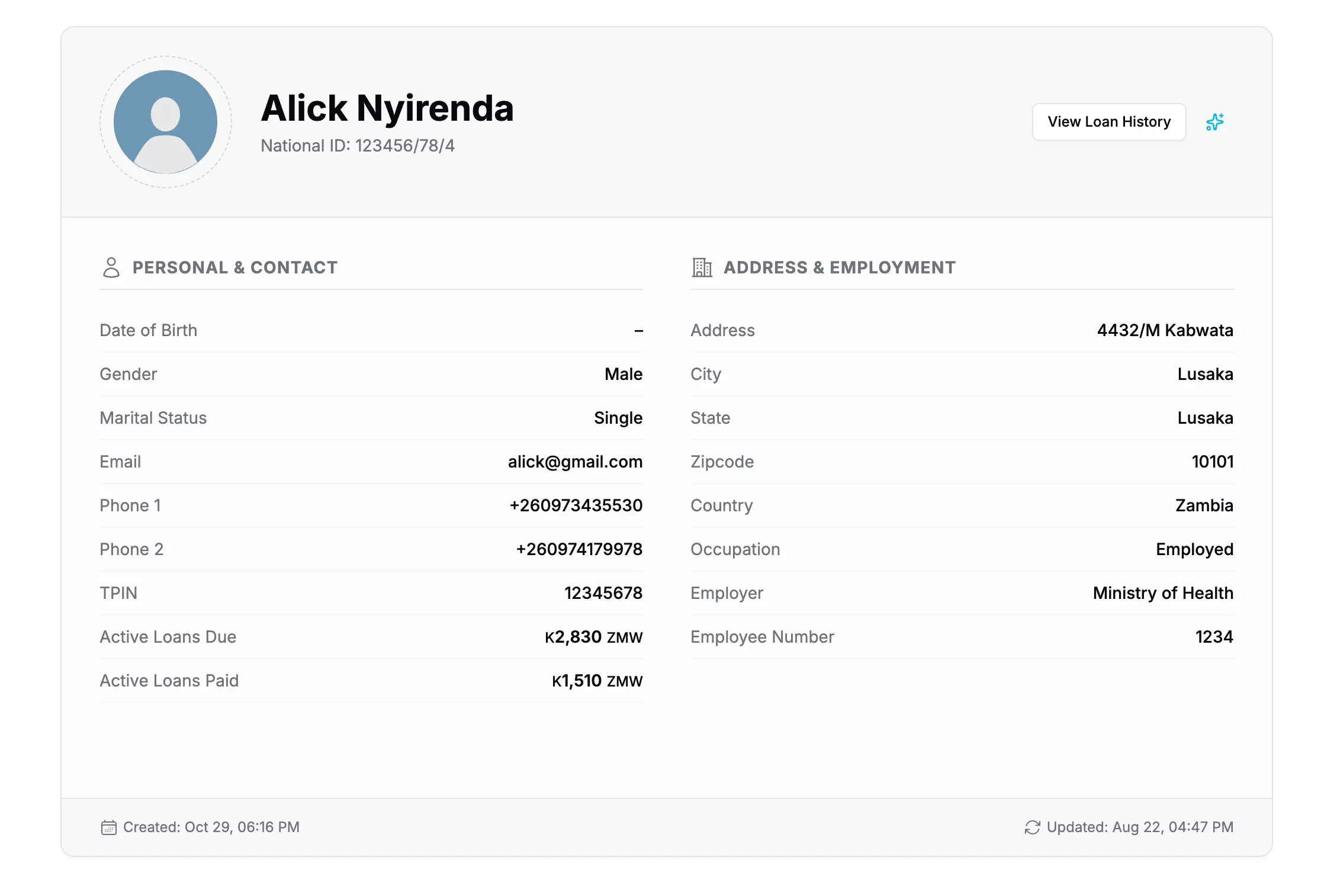
- 1KYC and identification — identity document, date of birth, verification status
- 2Contact and address, including the mobile money number payments arrive from
- 3Employer or business details, and stated income
- 4Guarantors, with what each of them is guaranteeing
- 5Next of kin
- 6Group or SACCO membership, where the borrower belongs to one
- 7Attached documents — ID copies, payslips, business records, signed agreements
Nothing here depends on a particular member of staff still working for you.
Credit history
Every past loan, and how it actually went
Repeat lending is where an MFI makes or loses money. The decision turns on what this borrower did last time, not on what they say this time.
The history shows every loan the borrower has taken from you: the amount, the product, whether it closed on schedule, how many days late the payments ran, and whether any of it was written off.
At appraisal, this is the screen the officer works from. A borrower who cleared three loans on time is not the same applicant as one who cleared three loans thirty days late — and without the history, both look identical on the application form.
What it does
What the record carries
Each of these is something that usually lives in an inbox, a WhatsApp thread or a filing cabinet.
Documents on the client
ID copies, payslips, business records and signed agreements attach to the borrower, not to an email thread. Anyone with permission to see that client can find the document, which means a repeat application does not start by asking the borrower for their ID again.
Guarantors and exposure
A guarantor is recorded against the loan they guarantee, and the client record shows everything a person is guaranteeing across your book. Before you accept the same well-known trader as guarantor for a fifth loan, you can see the four already standing.
Client statements and balances
A statement across all of a borrower’s loans, showing what was disbursed, what was received, and what is outstanding. It is the document to hand over when a borrower disputes a balance, and the one to file when an auditor asks about a particular customer.
Search and filtering
Find a borrower by name, identification number or phone number. Filter the client base by branch, by loan officer, by whether they currently hold a loan. It is how you answer questions such as which clients at one branch have no active loan and cleared their last one on time.
Branch scoping
Which clients a staff member can see follows the branches they work in. A loan officer sees their branch. A regional manager sees several. Head office sees everything. Nobody browses the whole client base because their login happened to allow it.
Duplicate prevention
The same borrower entered twice is two half-histories, and the second one always looks like a clean record. Lendbox warns when an identification number already exists on the system, so a repeat borrower is matched to the file you already hold on them.
When staff turn over
The officer leaves. The record does not.
Staff turnover is normal, and in field lending it is frequent. The risk is not that someone resigns — it is that the only account of a borrower resigns with them.
Because every field, document and decision was written to the client record as it happened, the officer who takes over the portfolio starts from what the institution knows, not from what they can reconstruct. The change history shows what was edited, by whom, and when.
- Handover is a permission change, not a rebuild of the file
- Every field edit is attributed and timestamped
- Deleted client records are recoverable from the recycle bin
- Nothing important lives only in a personal phone
Before you start
- Can we bulk import the client list we already have?
- Yes. Import your existing clients from a spreadsheet, including identification details, contacts and branch. Duplicate checks run on the way in, so an import does not create two records for the same borrower.
- Who can reach our client data?
- Data is encrypted in transit and at rest, and access follows the permission and branch rules you set — staff see the clients their role and branch allow.
- We lend to groups, not only individuals. Does that work?
- Yes. A borrower can belong to a group or be a SACCO member, and the record shows that membership alongside their individual history. Group lending has its own tooling in Lendbox for meetings, shared loans and guarantees.
Questions people ask
- It holds the institution’s record of every borrower — identification and KYC, contacts, guarantors, documents, group membership and the full history of loans taken and repaid — so lending decisions are made from what the institution knows rather than from what an individual officer remembers.
- Yes. Clients can be imported in bulk from a spreadsheet with their identification, contact and branch details, and duplicate checks run during the import.
- Yes. Every past loan appears on the client with its amount, product, repayment behaviour, days late and any amount written off. This is the view the loan officer uses at appraisal.
- Yes. Guarantors are recorded against the loans they guarantee, and the client record shows their total exposure across your whole book.
- Nothing. The record belongs to the institution, not to the officer. Handover is a change of permissions, and the change history shows every edit that has been made to the file.
- Yes. Members are held as clients with their SACCO membership recorded on the record, alongside their loans, guarantors and documents.
What does client management software do for a microfinance institution?
Can we import our existing borrower list?
Does the borrower record show previous loans and arrears?
Can we see everything one guarantor is standing behind?
What happens to a borrower’s record when the loan officer leaves?
Does Lendbox work for SACCO member management?
Whichever part brought you here, this comes with it
- Unlimited borrowers, loans and files
- No charge per record. Your bill does not grow because your book did.
- Your staff on web, Android and iOS
- The same data on a laptop at the branch and on a phone in the field.
- A complete audit trail
- Every action carries the name of the person who took it and the time they took it.
Put this on your own loan book
Create an account, set up one loan product, and run a real loan through it end to end. Nothing to install.
30-day free trial. No card required.