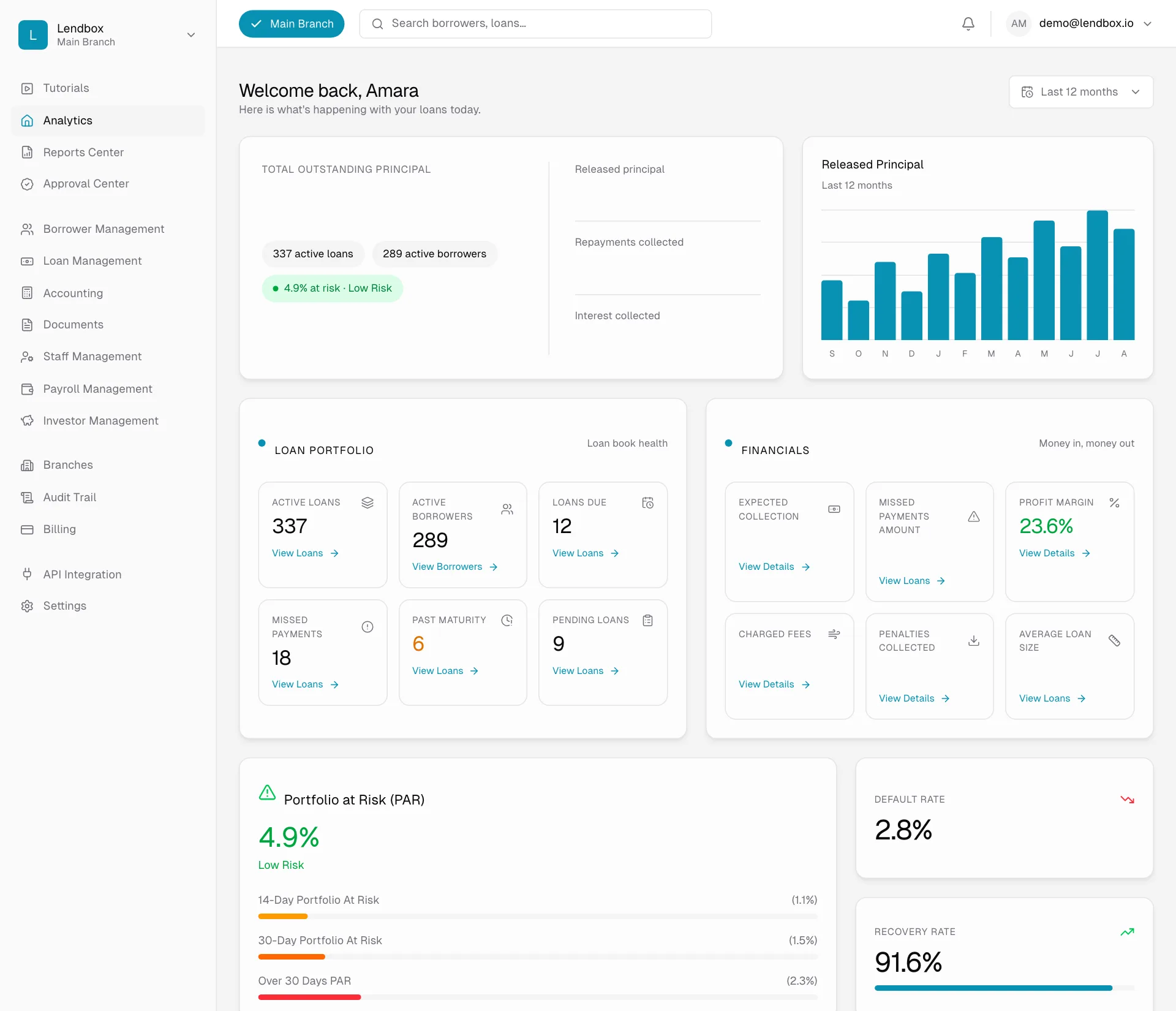
Built for SACCOs, digital credit providers and microfinance banks in Kenya: member loans, M-Pesa and check-off repayments, and the days-in-arrears figures your SASRA or CBK return asks for, all in Kenyan shillings.
Loan management software for Kenyan SACCOs and licensed lenders
Lendbox runs the lending side of a SACCO or credit provider in Kenya: loan records, repayments received through M-Pesa and employer check-off, and the arrears and portfolio-at-risk figures a SASRA or CBK return is built from, in KES from the first entry. See how Lendbox compares with other software for loan management.
How a Kenyan SACCO runs its loan book on Lendbox
From member application to the SASRA return, one loan record at a time
The stages below are the ones a SACCO credit office or a licensed digital lender in Kenya already runs. Lendbox keeps each one on the same loan record, so the figure in a return traces back to the member who repaid.
01
Member and borrower onboarding
Import existing members from a spreadsheet, or add them one at a time with the national ID and phone number on file. Scanned IDs and payslips are checked by AI document verification before the loan is appraised.
02
Application and appraisal
Capture the loan application against the product the member qualifies for, with the repayment schedule priced the way the SACCO prices it: flat or reducing balance, monthly or on the member's pay date.
03
Committee approval
Route the application through the approval ladder the credit committee uses, with every approve or decline logged against the loan and the reason kept with it.
04
Disbursement in shillings
Record the disbursement to the member's bank or M-Pesa line, print the loan agreement and schedule, and post the journal entries to the general ledger automatically.
05
Check-off and M-Pesa repayments
Post an employer check-off remittance as one bulk batch from the Excel template, and record PayBill repayments against the loan as they land. Reminders go out by SMS, email or WhatsApp ahead of each due date.
06
Arrears, PAR and the return
Ageing buckets give the days in arrears per loan, so the performing, watch, substandard, doubtful and loss figures a SASRA return asks for come from the book rather than from a month-end spreadsheet.
Lending in Kenya
Who regulates whom in Kenya, and what it means for your loan book
Kenya splits credit regulation by institution type. Each regulator asks for its own classification of the book, so the software has to give you the days-in-arrears view those returns are built on.
SACCOs
SASRA (Sacco Societies Act, 2008)
Deposit-taking SACCOs are licensed and supervised by SASRA, and specified non-deposit-taking SACCOs have reported to it since 2021. Returns classify loans by days in arrears. Lendbox's ageing buckets and portfolio-at-risk report give you that view per loan, product and branch; map the buckets to the classes your return uses.
Digital credit providers
Central Bank of Kenya (Digital Credit Providers Regulations, 2022)
App-based and online lenders need a CBK licence and must keep records of pricing, collections conduct and complaints. Every reminder sent and every repayment posted in Lendbox is logged against the loan, so the collections trail exists before anyone asks for it.
Microfinance banks
CBK (Microfinance Act, 2006)
Deposit-taking microfinance banks report prudential returns to the Central Bank. Lendbox provides the loan-side ledger: a double-entry general ledger, trial balance, profit and loss and balance sheet, with every loan transaction traceable to its journal entry.
Credit reference bureaus
TransUnion, Metropol, Creditinfo
Licensed lenders share repayment data with the CRBs. Lendbox keeps a full repayment history per borrower and per loan, so the record you report from is the same one your officers work from.
Pricing and disclosure
Annual percentage rate and total cost of credit
Kenyan lenders disclose the full cost of credit to the borrower. Lendbox prints the schedule with interest, fees and penalties itemised, and the free effective interest rate calculator on this site shows what a flat rate costs as an APR.
Shillings in, shillings out, and a PayBill number on every statement
The book, the statements and the reports run in Kenyan shillings. Repayments reach the loan the way they reach you today: Lendbox records them, it does not sit between you and Safaricom.
Books in KES
Set the workspace currency to Kenyan shillings once and every loan, schedule, statement and financial statement follows.
Loan agreements and schedules printed in KES
Trial balance, P&L and balance sheet in KES
Member statements with the running balance in shillings
M-Pesa and check-off repayments
Record a PayBill or Till repayment against the loan as it lands, and post an employer check-off remittance as one bulk batch.
Your M-Pesa PayBill number printed on borrower statements
Bulk repayment batches from the Excel template for check-off runs
SMS, email and WhatsApp reminders before each due date
Kenyan payroll built in
Staff loans and payroll run in the same workspace, with the Kenyan statutory preset applied to each pay run.
NSSF, PAYE, SHIF and the Affordable Housing Levy
Staff loan repayments deducted on the pay run
Payslips emailed to staff from the run
Pricing
Plans for lenders in Kenya
Lendbox invoices in US dollars and takes payment by card; the shilling amounts below are an indicative conversion so a SACCO treasurer can set them against the current software budget.
Can Lendbox run a Kenyan SACCO's loan book in shillings?
Yes. Set the workspace currency to KES and every loan, repayment schedule, member statement and financial statement is kept in Kenyan shillings. Lendbox runs the lending side of the SACCO: loan records, repayments and arrears. Savings and share ledgers stay in the system you keep them in today.
How do M-Pesa PayBill repayments get onto the loan?
You record them. When a repayment lands on your PayBill or Till, an officer posts it against the loan from the dashboard or the mobile app, or you post the day's repayments as one bulk batch. Lendbox does not connect to Safaricom's API, so nothing is pulled automatically; what it does give you is the PayBill number printed on every borrower statement so members pay to the right place.
Does it handle employer check-off remittances?
Yes. A check-off remittance that covers many members is posted as a single bulk repayment batch from an Excel template, one row per member, and each row lands on the right loan. The batch is reviewed before it posts, so a mismatched payroll number is caught rather than silently misapplied.
Can I get the days-in-arrears figures a SASRA return asks for?
Lendbox gives you ageing buckets per loan (current, 1–30, 31–60, 61–90 and over 90 days) and the portfolio-at-risk report that sits on them, by product and branch. You map those buckets to the performing, watch, substandard, doubtful and loss classes your return uses. Lendbox does not file the return for you.
We are a CBK-licensed digital credit provider. Does Lendbox keep the collections trail the regulations expect?
Every reminder sent, every repayment posted and every change to a loan is logged against that loan with who did it and when. Reminders go out by SMS, email or WhatsApp on the schedule you set, so the record of what the borrower was told and when exists without anyone keeping a separate log.
Is there a Kenyan payroll preset for staff loans?
Yes. The payroll module ships a Kenya preset with NSSF, PAYE, SHIF and the Affordable Housing Levy, dated from the rules in force, and staff loan repayments are deducted on the pay run. The preset covers the statutory lines; anything your HR policy adds on top is configured per employee.
What does Lendbox cost for a lender in Kenya?
Basic, for a single branch and one staff login, is the entry plan; Business and Growth add branches and staff. Every plan is charged in US dollars by card, and the pricing grid on this page converts the dollar figures into shillings at an indicative rate so you can compare them with what the SACCO pays now.
We run the book in Excel today. How do members and loans get in?
Borrowers and running loans are imported from Excel in two uploads, with a preview that flags rows that will not match before anything is written. A SACCO with its members and running loans in two spreadsheets can be posting live repayments inside the first week of the 30-day trial.